

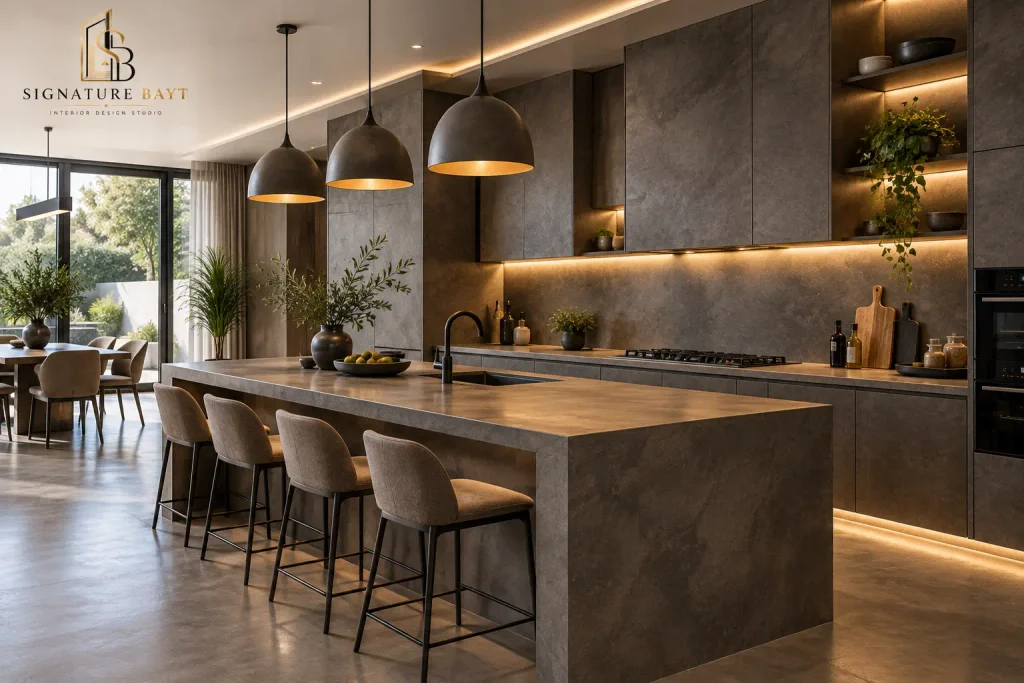
Microcement Kitchen Services Qatar offer a contemporary way to transform ordinary kitchens into elegant, seamless, and visually connected spaces. Instead of relying only on traditional tiles and multiple surface materials, microcement kitchen finishes can create a continuous design across selected walls, floors, splashbacks, and feature areas. As a result, modern kitchens can achieve a cleaner architectural appearance while still allowing homeowners to express their preferred style.
In Qatar, kitchen design increasingly forms an important part of the overall interior concept of villas, apartments, and premium properties. Therefore, material selection should consider not only appearance but also the kitchen layout, lighting, cabinetry, work surfaces, and daily usage. Microcement kitchen design works particularly well with minimalist, contemporary, industrial-inspired, and luxury interiors because designers can adapt its colour, texture, and finish to suit different concepts.
Moreover, microcement allows designers to create visual continuity between different kitchen areas. A coordinated wall finish can complement the flooring, while a carefully selected splashback can connect the cabinetry with the wider interior. When combined with wood, stone, glass, metal, and modern lighting, the result can become a sophisticated kitchen environment rather than simply another decorative surface.
Signature Bayt provides customized interior and finishing solutions designed around individual project requirements. We cover every stage from initial planning and surface assessment to material selection, application, and final finishing to create a complete kitchen concept. This guide explores Microcement Kitchen Services Qatar in detail, including applications, design styles, materials, installation, benefits, maintenance, cost factors, and important considerations before choosing a kitchen microcement company.
What Is Microcement for Kitchens?
Microcement for kitchens uses a decorative, cement-based finishing system that professionals apply in thin layers over properly prepared surfaces. It creates modern finishes across selected kitchen walls, floors, splashbacks, and feature areas. Its continuous appearance also offers a stylish alternative to conventional tiled interiors.
The final result depends on the selected material system, substrate preparation, application technique, colour, texture, and protective finish. Therefore, professionals should carefully plan each kitchen project before applying microcement
Understanding Microcement Kitchen Finishes
Microcement kitchen finishes can be customised to complement the architectural character of a property. Depending on the selected system, homeowners can explore smooth, matte, textured, neutral, warm, or concrete-inspired visual effects.
How Microcement Creates Continuous Surface Designs
Rather than creating a visual pattern from individual tiles, microcement can produce a more continuous surface appearance. Consequently, the kitchen may look calmer and more cohesive, particularly when several areas use coordinated finishes.
Key Features of a Premium Microcement Kitchen Finish
- Seamless visual appearance for contemporary kitchens.
- Custom colours that complement the interior palette.
- Multiple texture options for different design concepts.
- Modern decorative character suitable for premium interiors.
- Flexible application across selected kitchen surfaces.
Where Can Microcement Be Used in a Kitchen?
One of the main attractions of Microcement Kitchen Services Qatar is the ability to coordinate several surfaces within one design concept.
| Kitchen Area | Potential Microcement Application | Design Purpose |
|---|---|---|
| Kitchen Walls | Decorative wall finish | Creates a continuous background |
| Kitchen Floors | Microcement flooring | Provides a coordinated floor appearance |
| Splashbacks | Microcement splashback finish | Creates a seamless feature area |
| Feature Areas | Decorative surface | Highlights selected architectural elements |
| Selected Work Areas | Specialised finish where appropriate | Supports the overall design concept |
Microcement Kitchen Walls
Microcement kitchen walls can create a refined background behind cabinets, dining areas, appliances, or other architectural features. A carefully selected colour can either blend with the cabinetry or create a subtle contrast.
Creating Modern Feature Walls and Continuous Surfaces
Feature walls can give the kitchen a distinctive architectural character. At the same time, a continuous wall finish can help connect different areas of an open-plan interior.
Matching Wall Finishes with Kitchen Cabinets and Worktops
To create a cohesive result, coordinate the microcement colour and texture with the cabinet colours, worktops, flooring, handles, lighting, and other visible materials.
Microcement Kitchen Flooring
Microcement kitchen flooring can support a continuous and contemporary floor concept. It can be particularly effective in open-plan homes where the kitchen connects directly with dining or living spaces.
Creating Seamless and Contemporary Kitchen Floors
A continuous floor appearance can reduce strong visual breaks between different areas. Therefore, it can contribute to a more unified interior scheme.
Choosing Suitable Colours and Textures for Kitchen Flooring
Floor colour and texture should be selected according to the overall kitchen palette, lighting conditions, furniture, and desired visual atmosphere.
Microcement Kitchen Splashbacks
A microcement kitchen splashback can provide a modern alternative to conventional patterned or tiled splashback designs. It can create a visually continuous area behind selected kitchen workspaces.
Designing Seamless Splashback Surfaces
A seamless splashback can help simplify the visual appearance of the kitchen. However, the selected system and finishing requirements should be appropriate for the intended kitchen application.
Combining Splashbacks with Modern Kitchen Interiors
Microcement splashbacks can be coordinated with cabinets, worktops, lighting, and appliances to create a more unified kitchen composition.
Microcement Kitchen Solutions for Villas, Homes, and Apartments in Qatar
Kitchen requirements can vary significantly between villas, apartments, and residential renovations. As a result, custom microcement kitchen solutions should be planned around the property’s dimensions, existing surfaces, interior style, and daily usage.
| Property Type | Microcement Design Approach |
|---|---|
| Luxury Villas | Bespoke surfaces and statement finishes |
| Apartments | Space-conscious seamless designs |
| Family Homes | Functional and coordinated finishes |
| Renovation Projects | Modernising selected existing surfaces |
Luxury Microcement Kitchens for Qatar Villas
Large villa kitchens often provide greater opportunities for custom finishes and coordinated materials. Microcement can be used as part of a broader luxury interior concept alongside premium cabinetry, islands, lighting, wood, stone, and metal details.
Designing Bespoke Kitchen Surfaces for Spacious Villas
In spacious kitchens, designers can use microcement on selected feature walls, flooring, splashbacks, or other appropriate surfaces. This creates a consistent material language without making every surface identical.
Coordinating Microcement with Cabinets, Lighting, and Fixtures
The strongest results often come from coordination. Therefore, microcement should be considered alongside cabinet profiles, countertop materials, lighting temperature, handles, appliances, and decorative accessories.
Microcement Kitchen Solutions for Apartments
Apartment kitchens often need to balance limited space with strong visual design. Seamless surfaces can help reduce visual interruptions and create a more connected appearance.
Creating Visually Spacious Kitchen Interiors
Using coordinated colours across selected surfaces can make the kitchen feel visually calmer. Light and neutral microcement tones can also work well with contemporary cabinetry and lighting schemes.
Using Seamless Finishes in Compact Kitchen Layouts
In compact kitchens, unnecessary visual divisions can make the space feel busy. Consequently, carefully planned continuous surfaces can contribute to a cleaner appearance.
Custom Microcement Kitchens for Residential Renovations
Microcement can also be considered during kitchen renovation projects where homeowners want to introduce a contemporary material without redesigning every part of the interior.
Updating Existing Kitchen Surfaces with Modern Finishes
Professionals can prepare selected areas for a new decorative microcement finish based on the existing surface and its condition. They should assess the surface carefully before choosing the most suitable application method.
Combining New Microcement Surfaces with Existing Features
Renovation does not always require replacing every element. Microcement can potentially be coordinated with existing cabinetry, appliances, lighting, and furniture to create an updated visual direction.
Popular Microcement Kitchen Design Styles in Qatar
Kitchen interiors in Qatar can range from minimalist residential spaces to dramatic luxury kitchens. Fortunately, microcement can be adapted to several design directions through colour, texture, lighting, cabinetry, and complementary materials.
- Minimalist microcement kitchens with clean lines and restrained colours.
- Luxury contemporary kitchens with premium materials and refined finishes.
- Concrete-inspired kitchens with architectural character.
- Warm natural kitchens using earthy microcement tones.
- Modern open-plan kitchens with coordinated floor and wall surfaces.
Minimalist Microcement Kitchen Designs
Minimalist kitchens focus on simplicity, clean lines, limited visual clutter, and practical organisation. Microcement can support this approach through its continuous appearance and restrained surface character.
Using Neutral Colours and Clean Architectural Lines
White, beige, warm grey, taupe, and other neutral tones can create a calm backdrop for contemporary kitchen cabinetry.
Creating a Calm and Clutter-Free Kitchen Environment
When you carefully coordinate surfaces and storage, you create a cleaner kitchen appearance while maintaining the functionality needed for everyday use.
Luxury Contemporary Microcement Kitchens
Luxury kitchens often combine multiple premium materials. Microcement can provide a neutral or distinctive surface that complements stone, wood, glass, metal, and high-quality cabinetry.
Combining Microcement with Premium Kitchen Elements
A sophisticated kitchen can combine a subtle microcement wall with a stone island, timber cabinetry, metallic fixtures, and carefully positioned lighting.
Using Lighting, Stone, Wood, and Metal for Contrast
Contrasting materials add depth to the interior. Therefore, microcement can serve as a balanced background for richer architectural details.
Concrete-Inspired Microcement Kitchen Designs
Concrete-inspired finishes can introduce a strong architectural quality. However, the overall effect can remain elegant when balanced with warm lighting, refined cabinetry, and natural materials.
Creating Modern Industrial-Inspired Surfaces
Grey and textured finishes can create an industrial-inspired character while still fitting into contemporary residential interiors.
Balancing Concrete Effects with Elegant Kitchen Details
The use of warm wood, premium handles, decorative lighting, and refined fixtures can soften the architectural character of concrete-inspired surfaces.
Warm and Natural Microcement Kitchen Interiors
Warm microcement kitchens use earthy colours and natural materials to create an inviting environment. This approach can be particularly suitable for residential kitchens designed around comfort and everyday living.
Using Beige, Sand, Taupe, and Earth-Inspired Colours
Natural colour palettes can work with both modern and traditional-inspired cabinetry. They can also complement wood flooring, stone details, and warm lighting.
Combining Microcement with Natural Wood and Stone
Wood and stone provide texture and contrast, while microcement maintains a visually continuous foundation. Together, these materials can create a balanced kitchen interior.
Premium Microcement Materials and Finishing Options for Kitchens
The final appearance and suitability of a microcement kitchen depend on more than the decorative layer. Surface preparation, compatible materials, application methods, curing requirements, and protective finishing should all be considered before installation.
| Finish | Visual Character | Suitable Design Direction |
|---|---|---|
| Matte | Soft and understated | Minimalist interiors |
| Smooth | Clean and refined | Modern kitchens |
| Textured | More depth and character | Architectural interiors |
| Neutral | Versatile and balanced | Contemporary kitchens |
| Custom Colour | Personalised | Bespoke luxury interiors |
Choosing the Right Microcement System for a Kitchen
The selected system should correspond to the intended application and substrate. Therefore, professional assessment is useful before deciding whether microcement is appropriate for a specific kitchen surface.
Factors to Consider Before Selecting Materials
Important considerations include the existing surface, intended application, exposure conditions, design requirements, finishing system, and maintenance expectations.
Matching Material Selection with the Intended Kitchen Application
A wall, floor, splashback, or other kitchen surface may have different requirements. Consequently, the material system should be selected according to its intended use rather than purely by appearance.
Microcement Colours and Textures
Colour and texture are central to the final character of the kitchen. A subtle finish can blend with the architecture, while a stronger texture can become a feature element.
Smooth, Matte, Textured, and Decorative Finishes
Each finish creates a different visual effect. Therefore, samples and design references can help when selecting the final appearance.
Selecting a Finish That Complements the Overall Interior
The finish should work alongside kitchen cabinets, worktops, flooring, appliances, lighting, and adjacent living spaces.
Protective Finishes for Kitchen Surfaces
Protective finishing is an important part of many microcement systems. The appropriate treatment should be selected according to the material system and intended application.
Why Proper Surface Protection Matters
Correct finishing can help support the intended performance and appearance of the completed surface. Therefore, installation should follow the requirements of the selected system.
Following Suitable Care and Maintenance Requirements
After installation, the kitchen surface should be maintained according to the specific cleaning and care recommendations provided for the system.
Signature Bayt Microcement Kitchen Installation Process
A successful microcement kitchen installation requires careful planning from the initial consultation through to the final inspection. Signature Bayt can approach the process by considering the kitchen layout, existing surfaces, preferred design, material selection, application requirements, and final finishing.
- Initial consultation to understand project requirements.
- Kitchen assessment to review surfaces and layout.
- Surface preparation before microcement application.
- Professional application according to the selected system.
- Final finishing and inspection before completion.
Initial Consultation and Kitchen Design Planning
The project begins by understanding the kitchen’s size, layout, style, preferred colours, application areas, and surrounding materials. This creates a clearer direction before installation begins.
Understanding the Kitchen Layout and Design Requirements
The layout influences where microcement may be most effective. Open-plan kitchens, compact kitchens, kitchen islands, feature walls, and dining connections may each require a different approach.
Selecting Colours, Textures, and Application Areas
Colour and texture selections should be made alongside cabinetry, worktops, flooring, lighting, and other interior materials to maintain visual harmony.
Surface Inspection and Preparation
Before application, the existing surface should be inspected and prepared according to the requirements of the selected microcement system. Proper preparation is essential for a consistent finished surface.
Preparing Existing Walls, Floors, and Suitable Surfaces
The preparation method depends on the existing material, condition, and intended application. Any unsuitable conditions should be addressed before decorative layers are applied.
Creating a Suitable Base for Microcement Application
A properly prepared substrate helps support consistent application and reduces avoidable surface problems during the finishing stages.
Professional Microcement Application
Microcement is typically applied through a controlled sequence of layers. Each stage should be completed appropriately before the next stage begins, according to the selected system.
Applying the Required Layers and Finishes
Application techniques influence the final texture and appearance. Therefore, careful workmanship is important when creating large continuous surfaces.
Maintaining Consistent Texture and Surface Appearance
Edges, corners, transitions, and large surface areas require attention so that the completed kitchen maintains a cohesive visual character.
Final Finishing and Quality Inspection
Once the decorative application is complete, the appropriate protective finishing can be applied. A final inspection can then review the surface appearance, details, and overall completion.
Applying the Appropriate Protective Finish
The finishing system should correspond to the selected microcement and intended application. Following the manufacturer’s or installer’s requirements is important.
Checking Edges, Corners, Transitions, and Overall Surface Quality
Attention to final details helps ensure that the kitchen looks consistent and professionally completed.
Benefits of Microcement Kitchen Services Qatar
Microcement Kitchen Services Qatar can support both aesthetic and design objectives when the appropriate system is selected and professionally installed. Its continuous appearance, customisation options, and compatibility with contemporary interiors make it an interesting material for modern kitchen projects.
- Seamless visual design across selected kitchen surfaces.
- Custom colour options for personalised interiors.
- Multiple textures and finishes for different design styles.
- Contemporary appearance suitable for modern properties.
- Design continuity between connected kitchen areas.
- Flexible styling with wood, stone, metal, and glass.
Creating Seamless and Contemporary Kitchen Interiors
Continuous surfaces can reduce visual interruptions and help create a more unified interior. This can be particularly useful in open-plan kitchens that connect with dining or living areas.
Reducing Visual Breaks Across Selected Surfaces
When walls, floors, or feature areas use coordinated finishes, the kitchen can appear more visually connected.
Creating a More Cohesive Kitchen Design
A consistent material palette helps different elements work together rather than competing for attention.
Flexible Kitchen Design and Customisation
Microcement can support different visual concepts because the colour, texture, and finish can be selected according to the interior design direction.
Choosing Custom Colours, Textures, and Finishes
Customisation allows the material to complement existing or newly selected cabinetry, worktops, flooring, and lighting.
Matching Microcement with the Property’s Interior Style
Whether the property uses minimalist, contemporary, warm, or industrial-inspired design, the microcement finish can be selected to support the wider interior concept.
Microcement Kitchen Solutions for Commercial Properties in Qatar
Microcement is not limited to residential kitchens. It can also form part of commercial interior concepts where a contemporary appearance and coordinated surface design are important. However, commercial applications should always be planned according to the property’s operational requirements.
| Commercial Property | Potential Application |
|---|---|
| Restaurants | Customer-facing feature surfaces and selected kitchen areas |
| Cafés | Decorative walls and coordinated interior finishes |
| Hotels | Premium kitchen and hospitality interiors |
| Commercial Offices | Pantry and staff kitchen design features |
Microcement Kitchens for Restaurants and Cafés
Restaurants and cafés often place strong emphasis on interior atmosphere. Microcement can be incorporated into selected walls, floors, counters, or feature areas where the chosen system is suitable.
Creating Modern Customer-Facing Kitchen Areas
Open kitchens and visible service areas can benefit from coordinated finishes that complement the restaurant’s broader interior identity.
Coordinating Kitchen Finishes with Commercial Interior Design
Colour, texture, lighting, furniture, signage, and architectural materials should be considered together when designing a commercial kitchen environment.
Microcement Solutions for Hotels and Hospitality Spaces
Hotels can use coordinated microcement finishes to support a consistent design language across selected hospitality areas.
Developing Consistent Interior Finishes
A consistent colour and texture palette can help maintain a recognisable interior direction throughout different spaces.
Creating Premium Kitchen and Service Areas
Microcement can contribute to a sophisticated design concept when coordinated with appropriate cabinetry, fixtures, lighting, and other materials.
Why Choose Signature Bayt for Microcement Kitchen Services Qatar?
Choosing a kitchen finishing company involves more than selecting a material. The company should understand the relationship between the kitchen layout, interior design, surface preparation, material selection, and final finishing. Signature Bayt approaches kitchen projects with attention to these interconnected elements.
- Custom kitchen finishing solutions based on individual requirements.
- Design-focused planning for modern residential and commercial interiors.
- Attention to surface preparation before application.
- Detailed finishing across selected kitchen surfaces.
- Interior coordination between microcement and other materials.
Custom Kitchen Finishing Solutions
Every kitchen has different dimensions, lighting, cabinetry, materials, and design objectives. Therefore, a customised approach can help ensure that the selected microcement finish fits naturally within the space.
Understanding Individual Design and Space Requirements
Understanding how the kitchen is used and how it connects with surrounding rooms helps establish a more practical and visually consistent design direction.
Developing a Microcement Solution Around Your Kitchen Concept
The aim is to select appropriate surfaces, colours, textures, and finishing details around the existing or planned kitchen concept.
Professional Planning and Installation
Planning and installation should work together. A visually attractive concept still requires appropriate surface preparation and detailed execution to achieve the intended appearance.
Combining Design Planning with Detailed Surface Preparation
The design concept should be considered before preparation begins so that the installation process supports the desired result.
Maintaining Consistency from Preparation to Final Finish
Attention at every stage can help maintain consistency across large surfaces, corners, edges, and transitions.
Complete Interior Coordination
Microcement works best as part of a complete interior concept rather than as an isolated material. Signature Bayt can consider how the finish interacts with furniture, cabinetry, lighting, and architectural elements.
Matching Microcement with Kitchen Furniture and Fixtures
Cabinet colours, handles, worktops, appliances, lighting, and flooring should be reviewed alongside the microcement finish.
Creating a Unified Modern Kitchen Interior
When these elements are planned together, the kitchen can achieve a stronger sense of visual balance and continuity.
Latest Microcement Kitchen Trends in Qatar
Modern kitchen design continues to explore seamless surfaces, natural colours, mixed materials, integrated storage, and visually clean layouts. As a result, microcement can fit naturally into several contemporary kitchen trends.
- Seamless minimalist kitchen surfaces.
- Warm beige, taupe, sand, and grey finishes.
- Microcement combined with natural wood.
- Microcement paired with stone and metal.
- Integrated kitchen storage and clean architectural lines.
Seamless Minimalist Kitchen Surfaces
Minimalist kitchens continue to focus on clean surfaces and reduced visual clutter. Microcement can support this direction through its continuous appearance.
Why Continuous Finishes Are Popular in Modern Interiors
Continuous finishes can create visual consistency and allow architectural features, lighting, and cabinetry to become the main design elements.
Combining Minimalism with Functional Kitchen Design
A minimalist appearance should still support practical storage, circulation, preparation areas, and everyday kitchen use.
Warm Neutral Microcement Kitchen Colours
Warm neutral shades can create a welcoming atmosphere while remaining compatible with modern kitchen architecture.
Beige, Taupe, Sand, and Warm Grey Finishes
These colours can work with light and dark cabinetry and can also complement natural wood, stone, and metallic details.
Creating Soft and Sophisticated Kitchen Interiors
Neutral finishes allow the kitchen to remain elegant without overwhelming other important architectural features.
Microcement with Natural Wood and Stone
Combining different materials can add depth and contrast. Microcement provides a continuous foundation, while wood and stone introduce natural texture.
Creating Contrast Through Mixed Materials
Contrasting surfaces can help define different zones while maintaining an overall cohesive design.
Balancing Modern Surfaces with Natural Elements
Natural materials can soften the architectural character of microcement and create a more welcoming kitchen atmosphere.
Integrated and Contemporary Kitchen Design
Contemporary kitchens increasingly use integrated storage, concealed appliances, clean cabinetry lines, and carefully coordinated surfaces.
Combining Microcement with Built-In Storage
A continuous microcement surface can provide a simple backdrop for built-in storage and streamlined cabinetry.
Creating Clean Lines and Visually Connected Surfaces
Coordinating walls, floors, cabinetry, and lighting can help create the clean architectural character associated with modern kitchens.
Microcement Kitchen Maintenance and Care
After installation, appropriate maintenance is important for preserving the appearance of a microcement kitchen finish. Cleaning and care requirements can vary depending on the specific material and protective system used.
- Use cleaning products appropriate for the installed system.
- Avoid unnecessarily abrasive cleaning methods.
- Clean spills and residue regularly.
- Follow the installer or manufacturer’s maintenance guidance.
- Address maintenance concerns appropriately rather than using unsuitable treatments.
Everyday Cleaning for Microcement Kitchen Surfaces
Regular and gentle cleaning can help maintain the visual quality of finished surfaces. However, the specific cleaning products should always correspond to the installed system.
Choosing Suitable Cleaning Methods
Use cleaning methods recommended for the specific microcement and protective coating. Avoid assuming that every cleaning product is suitable for every surface system.
Avoiding Unnecessary Abrasive Cleaning Practices
Harsh or abrasive treatments may not be appropriate for every finish. Therefore, following the specified care instructions is preferable.
Protecting Microcement Kitchen Finishes
Protective finishing forms part of the overall microcement system. Appropriate care after installation helps maintain the intended appearance.
Following Recommended Maintenance Guidelines
Maintenance instructions should be provided according to the actual material and finishing system installed in the kitchen.
Maintaining the Appearance of Finished Surfaces
Consistent care can help preserve the clean and contemporary appearance that makes microcement attractive for modern kitchen interiors.
Cost Factors for Microcement Kitchen Services in Qatar
The cost of a microcement kitchen project can vary according to the size of the area, existing surface condition, number of surfaces being treated, design complexity, selected finish, preparation requirements, and installation method. Therefore, an accurate project assessment is more useful than relying on a single standard price.
| Cost Factor | How It Can Influence the Project |
|---|---|
| Surface Area | Larger areas require more preparation and material. |
| Existing Surface | Additional preparation may be required. |
| Design Complexity | Detailed designs can require additional work. |
| Finish Selection | Different finishes may have different material requirements. |
| Application Areas | Walls, floors, splashbacks, and features may require different approaches. |
What Influences Microcement Kitchen Installation Costs?
Project pricing is influenced by both material and labour requirements. Consequently, the kitchen should be assessed before determining the appropriate scope of work.
Kitchen Size and Surface Area
A larger kitchen or a project covering multiple surfaces naturally requires more preparation, material, application, and finishing work.
How Existing Surface Conditions Can Affect the Project
If existing surfaces require significant preparation or correction, this can influence the overall project scope.
Material, Finish, and Design Complexity
Custom colours, textures, detailed transitions, multiple application areas, and specific finishing requirements can all affect the work involved.
Understanding the Impact of Custom Finishes
More customised finishes may require additional planning, sample approval, and application attention.
Planning the Project According to Your Requirements
Defining the required surfaces, design style, colour, texture, and finish in advance can make project planning clearer and more efficient.
Important Factors Before Choosing a Microcement Kitchen Company in Qatar
Before selecting a company, it is important to evaluate more than the appearance of completed images. Experience, preparation methods, material knowledge, customisation capabilities, communication, and finishing quality can all influence the final result.
| Factor | What to Evaluate |
|---|---|
| Experience | Previous microcement kitchen projects |
| Surface Preparation | Methods used before application |
| Materials | Suitability for the intended application |
| Customisation | Colour, texture, and design options |
| Finishing | Final appearance and protective treatment |
Review Previous Microcement Kitchen Projects
Reviewing completed projects can help you understand whether the company has experience with different kitchen layouts, surface types, design styles, and finishing requirements.
Evaluating Design Variety and Installation Quality
Look for consistency in large surfaces, corners, transitions, colour application, and final finishing details.
Looking for Consistent Finishing and Attention to Detail
Small details can influence the overall appearance of a kitchen, particularly when large seamless surfaces are involved.
Evaluate Materials and Surface Preparation
Ask which microcement system is proposed and how the existing surface will be prepared. This helps ensure that the selected solution is appropriate for the intended application.
Understanding the Proposed Microcement System
Different applications may have different technical requirements. Therefore, the material should be selected according to the actual surface and project conditions.
Asking About Application and Protective Finishing Methods
Understanding the application sequence and final protective treatment can provide a clearer picture of how the completed kitchen will be maintained.
Consider Customisation and Design Support
If the goal is a bespoke kitchen, the company should be able to discuss colours, textures, application areas, and how the microcement will interact with existing interior materials.
Discussing Colours, Textures, and Kitchen Applications
Clear discussion before installation helps reduce uncertainty and ensures that the design direction is understood by everyone involved.
Ensuring the Company Understands Your Design Vision
A good project starts with a clear understanding of the desired kitchen atmosphere, materials, layout, and practical requirements.
Conclusion: Transform Your Kitchen with Microcement Kitchen Services Qatar
Microcement Kitchen Services Qatar provide a modern approach to creating sophisticated and visually connected kitchen interiors. From walls and floors to splashbacks and selected feature surfaces, microcement can support a wide variety of contemporary design concepts when the appropriate system is selected and professionally installed.
Its flexibility also makes it suitable for different property types, including luxury villas, apartments, family homes, restaurants, hotels, and selected commercial spaces. Furthermore, the ability to coordinate colours, textures, cabinetry, lighting, wood, stone, and metal allows microcement to become part of a complete interior design rather than an isolated finish.
However, the quality of the final result depends on more than the decorative material. Proper surface preparation, suitable material selection, detailed application, appropriate protective finishing, and correct maintenance all play an important role. Therefore, careful planning should be completed before the installation begins.
Signature Bayt provides customised interior and finishing solutions designed around the specific requirements of each project. Whether you are creating a new luxury kitchen or updating an existing space, discussing your layout, preferred style, surface requirements, colours, and finishing expectations can help establish a clearer project direction.
With thoughtful planning and professional execution, a modern microcement kitchen can become a distinctive part of a contemporary Qatar interior, combining clean visual lines, personalised finishes, and a cohesive design language.
Frequently Asked Questions About Microcement Kitchen Services Qatar
1. What are Microcement Kitchen Services Qatar?
Microcement Kitchen Services Qatar include customised microcement finishing solutions for suitable kitchen surfaces such as walls, floors, splashbacks, and selected feature areas.
2. Can microcement be used on kitchen floors and walls?
Yes, microcement can be used on suitable kitchen walls and floors when the substrate, material system, preparation, and finishing method are appropriate for the intended application.
3. Can microcement be used for kitchen splashbacks?
Microcement can be considered for selected splashback applications when the chosen system and protective finishing are appropriate for the intended kitchen environment.
4. Is microcement suitable for modern kitchen interiors?
Yes. Its continuous appearance and range of colours and textures make microcement suitable for minimalist, contemporary, industrial-inspired, and luxury kitchen concepts.
5. Can microcement kitchen colours and textures be customised?
Depending on the selected system, different colours, textures, and decorative finishes may be available to match the overall kitchen design.
6. Can microcement be applied to existing kitchen surfaces?
It may be possible depending on the existing surface condition and the requirements of the selected system. A professional surface assessment should be completed first.
7. How long does microcement kitchen installation take?
The installation period depends on the kitchen size, surface condition, number of application areas, design complexity, layer requirements, drying or curing time, and final finishing.
8. How should microcement kitchen surfaces be cleaned?
Cleaning should follow the recommendations for the specific microcement and protective finishing system installed. Suitable products and non-abrasive methods are generally preferred where specified.
9. Why choose Signature Bayt for microcement kitchen services in Qatar?
Signature Bayt focuses on customised interior and finishing solutions, with attention to design planning, surface preparation, material coordination, application, and final finishing.
10. How can I start a microcement kitchen project in Qatar?
Start by discussing your kitchen layout, preferred design, application areas, colours, textures, existing surfaces, and finishing requirements with Signature Bayt so the project can be planned around your specific needs.
Transform your kitchen with Microcement Kitchen Services Qatar and create a modern, elegant, and seamless interior tailored to your space with Signature Bayt.