

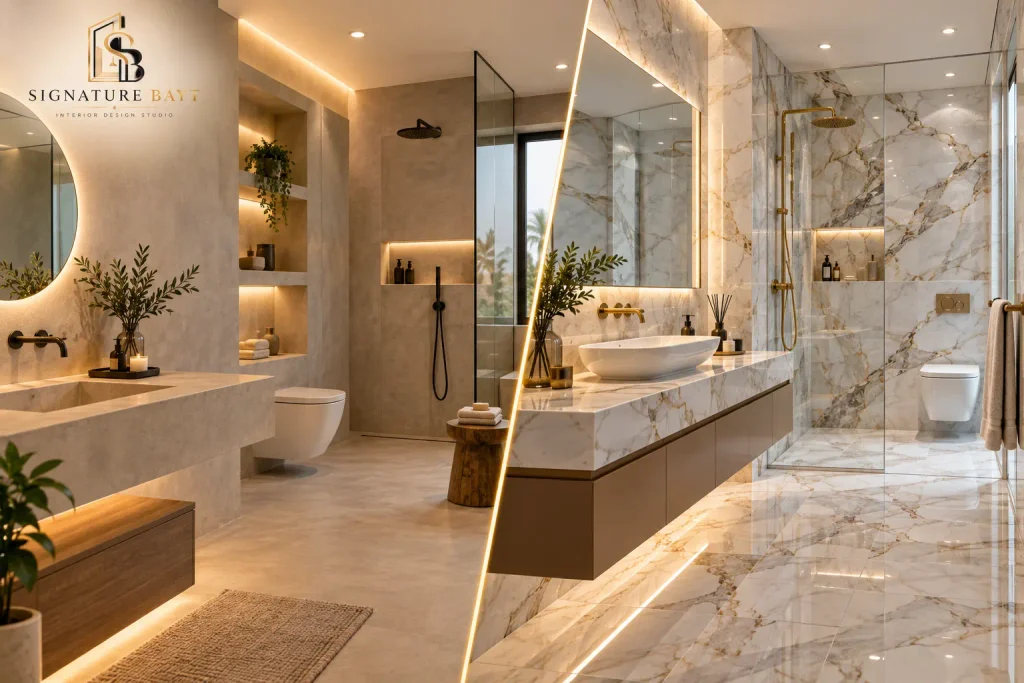
Microcement vs Tiles is an important comparison for homeowners, designers, and property owners planning a modern interior in Qatar. Both finishes can create attractive surfaces, yet they produce very different visual and practical results. While tiles offer familiar installation methods, extensive patterns, and many formats, microcement creates a more continuous appearance with fewer visible interruptions. Therefore, choosing between them requires more than simply comparing colours or patterns.
For luxury Qatar interiors, the decision should reflect the character of the property, the purpose of each room, the desired design language, and the way different surfaces work together. A contemporary villa, for example, may benefit from the calm appearance of a seamless microcement finish, while another project may require the visual variety and established format options that tiles provide. Similarly, bathrooms, kitchens, floors, walls, and commercial spaces may each require a different approach.
At Signature Bayt, material selection should form part of the wider interior concept. Instead of viewing microcement or tiles as isolated finishes, designers can consider them alongside cabinetry, lighting, glass, mirrors, furniture, architectural details, and other surfaces. As a result, the chosen finish can contribute to a more cohesive interior.
This guide provides a detailed comparison of microcement vs tiles, including appearance, design flexibility, installation, maintenance, application areas, cost factors, and suitability for modern Qatar interiors. By understanding the differences, you can make a more informed decision about which finish supports your home’s design goals, practical requirements, and desired level of visual sophistication.
Microcement vs Tiles: What Is the Difference?
The main difference between microcement and tiles lies in how they create the finished surface. Microcement uses a thin decorative cement-based system applied in layers over a suitably prepared substrate. Tiles, on the other hand, consist of individual pieces installed across a surface with joints between them.
Because of this difference, each material creates a distinct visual character. Microcement can produce a continuous appearance, while tiles can introduce patterns, grids, textures, colours, and individual design elements. Therefore, the better choice depends on the appearance and functionality you want to achieve.
What Is Microcement?
Microcement is a decorative surface system that uses thin layers to create a contemporary finish. Designers can use it on selected walls, floors, bathrooms, kitchens, and other suitable interior surfaces when the substrate and installation system allow it.
How Microcement Creates a Seamless Surface
Installers apply microcement across the prepared surface in controlled layers. Because the finished design does not rely on individual tile pieces and traditional grout lines, it can create a visually continuous appearance. However, the final result depends heavily on substrate preparation, application technique, material selection, and protective finishing.
Where Microcement Works Best
- Modern bathrooms.
- Contemporary kitchens.
- Feature walls.
- Selected interior floors.
- Minimalist residential interiors.
- Luxury villa interiors.
What Are Traditional Tiles?
Tiles are individual surface materials available in many colours, patterns, textures, shapes, and sizes. They remain a versatile option for residential and commercial interiors because designers can create different layouts using individual pieces and grout lines.
How Tile Finishes Differ by Material and Format
Tiles can vary significantly in appearance and format. Large-format tiles can reduce the number of visible joints, while smaller tiles can create decorative patterns. Similarly, different surface textures can support minimalist, classic, contemporary, or decorative interior concepts.
Where Tiles Work Best
- Bathroom walls and floors.
- Kitchen splashbacks.
- Kitchen flooring.
- Decorative feature walls.
- Residential floors.
- Commercial interiors.
Why Compare Microcement and Tiles Before Renovating?
Choosing a surface finish affects the appearance and overall character of an interior. Therefore, comparing microcement vs tiles before renovation can help you understand how each option fits your space, budget, design direction, maintenance expectations, and installation requirements.
Appearance, Performance, Maintenance, and Installation
A useful comparison should consider more than visual style. You should also evaluate the preparation requirements, installation process, surface care, surrounding materials, and intended use of the space.
Matching the Finish to Your Interior Concept
The finish should support the wider design concept. For example, a minimalist interior may benefit from a continuous microcement appearance, while a decorative interior may gain more character from patterned or textured tiles.
Microcement vs Tiles: Key Differences at a Glance
| Factor | Microcement | Tiles |
|---|---|---|
| Appearance | Continuous and contemporary | Individual pieces with visible joints |
| Design Style | Minimalist, modern, refined | Highly varied, from minimalist to decorative |
| Customisation | Colour and texture can be tailored | Wide range of colours, patterns, formats, and textures |
| Grout Lines | No traditional tile grid | Visible joints are generally part of the installation |
| Installation | Requires careful preparation and layered application | Requires layout, cutting, adhesive, and grouting |
| Maintenance | Depends on the finish and protective system | Requires care of both tile surfaces and grout |
| Design Character | Seamless and understated | Patterned, structured, or decorative |
Seamless Appearance
Microcement creates a continuous visual surface, making it particularly attractive for interiors where designers want fewer visual interruptions. Tiles naturally introduce joints, although large-format tiles can reduce their frequency.
Surface Texture and Visual Character
Microcement can create subtle texture and tonal variation, while tiles can provide everything from smooth polished surfaces to stone-inspired, patterned, textured, or decorative finishes.
Design Flexibility
Both materials provide design flexibility, but they achieve it differently. Microcement focuses on colour, texture, and continuity, whereas tiles provide variety through size, shape, pattern, layout, and surface design.
Maintenance Requirements
Both finishes require appropriate cleaning and care. With tiles, however, grout lines create additional areas that require attention. Microcement maintenance depends on the specific system and protective finish used.
Installation Considerations
Microcement requires careful substrate preparation and controlled application. Tile installation, meanwhile, requires accurate setting out, cutting, adhesive application, and grouting. Consequently, professional workmanship remains important for both options.
Long-Term Interior Appeal
Long-term visual appeal depends on the quality of the installation, the suitability of the material for the space, and how well the finish works with the overall interior concept. Therefore, design context matters as much as material selection.
Microcement vs Tiles for Luxury Qatar Interiors
Luxury interiors often depend on material coordination rather than excessive decoration. For that reason, the comparison between microcement vs tiles becomes especially relevant when designing villas, apartments, bathrooms, kitchens, and other premium spaces in Qatar.
Creating a Modern and Minimalist Look
Microcement can support minimalist interiors because its continuous appearance reduces the visual interruption created by traditional tile grids. Consequently, walls and floors can appear calmer and more unified.
Designing Seamless Contemporary Spaces
A seamless contemporary appearance can help connect different areas visually. When the same or complementary finish flows across suitable surfaces, the interior can feel more cohesive.
Combining Finishes with Luxury Materials
Microcement and tiles can both work alongside other premium interior materials. The final selection should complement the property’s architecture and the designer’s intended atmosphere.
Microcement with Natural Stone
The understated texture of microcement can contrast effectively with natural stone surfaces. This combination can create visual depth without introducing excessive pattern.
Microcement with Wood and Timber
Warm wood tones can soften the contemporary appearance of microcement. Therefore, the combination can work well in kitchens, bedrooms, living rooms, and other modern residential interiors.
Microcement with Glass and Mirrors
Glass and mirrors can introduce reflection and visual lightness, while microcement provides a grounded surface. Together, these materials can support sophisticated contemporary interiors.
Choosing Finishes for Villas and Premium Homes
- Consider the overall architectural style.
- Coordinate wall and floor finishes.
- Review lighting before selecting surface colours.
- Balance smooth, textured, and reflective materials.
- Choose finishes according to the purpose of each room.
Microcement vs Tiles: Which Creates a More Seamless Interior?
If your main design goal is a continuous surface, microcement has a clear visual advantage because it does not create the traditional grid of individual tile pieces and grout joints. This characteristic can help designers create a calmer and more uninterrupted appearance.
Why Microcement Creates a Continuous Visual Effect
Microcement forms a continuous decorative layer across the prepared surface. Therefore, it can create a flowing appearance across suitable walls and floors, subject to the substrate and project requirements.
How Tile Joints Influence the Overall Appearance
Tile joints naturally create a visual grid. Designers can use this grid creatively, but it remains an important part of the overall appearance. Grout colour and tile layout can therefore significantly influence the finished interior.
Using Large-Format Tiles for a Cleaner Look
Large-format tiles can reduce the number of visible joints compared with smaller tiles. Consequently, they can provide a cleaner appearance while retaining the characteristics of tiled surfaces.
When a Seamless Finish Makes More Design Sense
A seamless finish can make particular sense when the interior follows a minimalist or contemporary concept. It can also help connect multiple surfaces visually when designers use consistent colours and textures.
Microcement vs Tiles for Bathrooms
Bathrooms are one of the most important areas to consider when comparing microcement vs tiles. Both materials can contribute to attractive bathroom interiors, but they create different visual experiences and require different approaches to preparation, application, and finishing.
Why Microcement Works Well in Modern Bathrooms
Microcement can create a visually continuous bathroom because it avoids the traditional tile grid. This characteristic can complement minimalist vanities, contemporary fittings, glass shower panels, mirrors, and modern lighting.
How Tiles Perform in Bathroom Design
Tiles provide extensive design choices for bathrooms. Designers can combine different sizes, colours, patterns, textures, and layouts to establish a distinctive visual identity.
Microcement Shower and Wet-Area Applications
Microcement may be considered for suitable bathroom surfaces when the complete system and substrate are appropriate for the intended application. Proper preparation and protective finishing remain essential considerations.
Tile Layouts for Luxury Bathrooms
- Large-format minimalist layouts.
- Marble-inspired surfaces.
- Stone-effect finishes.
- Textured feature tiles.
- Geometric decorative patterns.
Comparing Bathroom Design and Maintenance
Microcement can reduce the visual interruption associated with grout lines, while tiled bathrooms provide established cleaning and replacement approaches. In either case, correct installation and appropriate maintenance are important for the finished result.
Choosing the Right Bathroom Finish for Your Qatar Home
Consider the bathroom’s size, lighting, architectural style, desired atmosphere, surrounding materials, and maintenance expectations. Consequently, the right choice should respond to the complete bathroom rather than one isolated feature.
Microcement vs Tiles for Kitchens
Kitchens require surfaces that work visually with cabinetry, worktops, appliances, lighting, and storage. Therefore, the choice between microcement and tiles should support both the kitchen’s practical layout and its overall design language.
Using Microcement on Kitchen Walls and Floors
Microcement can create a clean, contemporary appearance across selected kitchen walls and floors. Its restrained texture can work especially well with minimalist cabinetry and natural materials.
Using Tiles for Kitchen Splashbacks and Floors
Tiles remain versatile for splashbacks and floors because they provide a wide selection of formats, colours, patterns, and textures. Designers can also use them to create visual contrast against plain cabinetry.
Coordinating Surfaces with Cabinets and Worktops
For a cohesive kitchen, the wall or floor finish should relate to cabinet colours, worktops, handles, lighting, and appliances. As a result, the surface becomes part of the complete kitchen composition.
Comparing Kitchen Design Flexibility
Minimalist Kitchen Concepts
Microcement can support minimalist kitchens by reducing visible pattern and creating a continuous surface. This approach can work particularly well with handleless cabinetry and restrained colour palettes.
Contemporary Luxury Kitchens
Both microcement and premium tiles can support luxury kitchens. The choice should depend on whether the design requires a calm continuous finish or more visible material pattern and variation.
Industrial-Inspired Kitchens
Microcement can naturally complement industrial-inspired interiors because its texture can work alongside metal, timber, dark cabinetry, and concrete-inspired design elements.
Microcement vs Tiles for Floors
Flooring influences how an entire interior feels because it covers a large visual area. Consequently, comparing microcement flooring with tiled flooring requires attention to visual continuity, room proportions, design style, installation requirements, and everyday use.
Microcement Flooring for Modern Interiors
Microcement flooring can create a continuous visual field that helps connect different areas. This can be particularly effective in open-plan interiors where designers want fewer visual breaks between zones.
Tile Flooring for Residential Spaces
Tile flooring provides extensive design possibilities. Large-format tiles can create a relatively clean appearance, while patterned tiles can establish stronger visual identity.
Comparing Visual Continuity Across Large Areas
Microcement naturally supports visual continuity because the surface does not follow a traditional tile grid. Tiles can also create continuity when designers carefully coordinate large formats and grout colours, although joints remain part of the installation.
Considering Room Size and Layout
Large open rooms may benefit from a continuous finish, while smaller or more decorative rooms may gain character from carefully selected tile patterns. Therefore, room proportions should influence the decision.
Choosing a Floor Finish for High-Use Areas
High-use areas require careful consideration of the selected material system, substrate, installation quality, and maintenance requirements. The most suitable finish should always match the specific application.
Microcement vs Tiles for Walls
Walls provide an excellent opportunity to use surface finishes creatively. While tiles can introduce pattern and texture, microcement can provide a calmer continuous appearance that works particularly well with contemporary interiors.
Microcement Wall Finishes
Microcement wall finishes can create a refined backdrop for furniture, lighting, mirrors, artwork, and architectural features. The result depends on the selected colour, texture, application technique, and protective finish.
Decorative and Large-Format Tile Walls
Tile walls can create strong visual impact through patterns, stone-inspired surfaces, geometric arrangements, and different formats. Therefore, tiles can be particularly useful when the wall itself needs to become a decorative feature.
Creating Feature Walls with Microcement
A microcement feature wall can introduce texture without relying on strong patterns. Consequently, it can work well in living rooms, bedrooms, bathrooms, and other contemporary spaces.
Combining Wall Finishes with Lighting
Lighting can reveal surface texture and colour variation. Therefore, wall finishes should be selected alongside the lighting concept rather than considered independently.
Choosing Between Texture and Pattern
Choose microcement when subtle texture and continuity are priorities. Alternatively, choose tiles when pattern, visible layout, or decorative variation plays a central role in the design.
Microcement vs Tiles: Which Offers More Design Flexibility?
Both finishes can support creative interior design, but their flexibility appears in different ways. Microcement allows designers to work with colour, texture, and continuity, while tiles offer a vast range of shapes, formats, patterns, and surface appearances.
Colour Options and Customisation
Microcement can be selected in different colours and tones, allowing designers to develop a restrained or distinctive palette. Tiles, meanwhile, provide extensive ready-made colour collections and patterns.
Texture and Finish Selection
Microcement can create subtle surface variation, while tiles can replicate or interpret stone, concrete, marble, wood, geometric patterns, and many other visual concepts.
Creating Curved and Continuous Surfaces
Because microcement is applied as a surface system, it can support certain curved or continuous design concepts where the substrate and application system are suitable. Tiles may require more visible segmentation when following complex forms.
Coordinating Multiple Interior Elements
Microcement can provide a neutral background that allows furniture, lighting, glass, mirrors, and architectural details to become visual focal points. Tiles can instead contribute a stronger decorative layer when their pattern becomes part of the design.
Designing a Consistent Look Across Different Rooms
Using complementary finishes across several rooms can create visual continuity throughout a property. Designers can use microcement for a consistent contemporary language or combine it strategically with selected tile surfaces.
Microcement vs Tiles: Installation Considerations
Installation quality can influence the final appearance of both materials. Therefore, homeowners should evaluate not only the material itself but also the preparation and workmanship required to install it correctly.
How Microcement Installation Works
Surface Preparation
The substrate needs appropriate preparation before application. Existing conditions, surface stability, cleanliness, level, and suitability should be assessed before the microcement system is applied.
Layer Application
Microcement is applied in thin layers according to the selected system. Each stage contributes to the final texture, appearance, and surface quality.
Colour and Texture Selection
The desired colour and texture should be selected as part of the wider interior palette. Lighting should also be considered because it can influence how the finished surface appears.
Protective Finishing
The final protective system should match the intended application. Therefore, the installation process should follow the requirements of the specific microcement system being used.
How Tile Installation Works
Surface Preparation
The surface should be suitably prepared before tile installation begins. Accurate preparation helps create a more stable and visually consistent finished surface.
Tile Layout and Cutting
Installers establish the layout before positioning tiles. Careful planning helps manage cuts, edges, corners, transitions, and overall symmetry.
Adhesive and Grouting
Tiles require appropriate adhesive and joint treatment according to the installation system. Grout colour can also influence the final visual appearance.
Final Finishing
After installation, the surface should be checked for alignment, joints, edges, transitions, and finishing details. This final review helps achieve a cleaner result.
Why Professional Installation Matters
Both microcement and tiles require appropriate preparation and skilled application. Even high-quality materials may produce an unsatisfactory result when installers overlook substrate conditions, measurements, alignment, finishing, or other critical details.
How Existing Surfaces Can Affect the Project
Existing walls and floors may contain uneven areas, movement, moisture-related issues, old finishes, or other conditions that influence the renovation process. Therefore, an assessment should take place before choosing the final application method.
Microcement vs Tiles: Maintenance and Cleaning
Maintenance is another important factor in the microcement vs tiles comparison. Neither finish should be selected solely because it appears easy to clean. Instead, consider the specific material system, protective finish, room conditions, cleaning habits, and installation quality.
Maintaining a Microcement Surface
Microcement surfaces should receive cleaning and care appropriate to their protective finish. Avoid unsuitable or abrasive cleaning methods that could affect the surface.
Maintaining Tiled Surfaces
Tiles generally require regular cleaning of the tile surface as well as attention to grout lines. The appropriate cleaning method depends on the type of tile and grout installed.
Managing Grout Lines and Joints
Grout can accumulate dirt or discolour over time, especially in areas exposed to moisture or frequent use. Consequently, tiled interiors require attention to both the tiles and the joints.
Choosing Cleaning Methods Carefully
- Follow the recommended care instructions.
- Use suitable cleaning products.
- Avoid unnecessarily abrasive materials.
- Clean spills and marks regularly.
- Pay attention to high-use and moisture-prone areas.
Planning for Long-Term Surface Care
Before selecting a finish, consider how much maintenance you are comfortable performing. A beautiful surface should also fit your everyday lifestyle and maintenance expectations.
Microcement vs Tiles: Durability and Everyday Use
Durability should always be evaluated in relation to the specific application rather than treated as a simple competition between two materials. The substrate, installation system, protective finish, environmental conditions, and everyday use can all influence the final performance.
Understanding Surface Performance
A surface performs according to how appropriately it has been selected and installed for its intended location. Therefore, bathrooms, kitchens, living areas, and commercial spaces should each receive appropriate consideration.
How Daily Use Can Affect Each Finish
Frequent movement, furniture, cleaning, moisture, and other everyday factors can affect interior surfaces. Consequently, material selection should consider the specific demands of the room.
Considering Moisture and High-Use Areas
Bathrooms and kitchens require particularly careful planning because moisture and frequent cleaning form part of everyday use. The selected system should therefore be appropriate for the intended environment.
Why Surface Preparation Influences Results
Preparation provides the foundation for the finished surface. Therefore, identifying and addressing substrate conditions before installation can be an important part of achieving a successful result.
Choosing According to the Specific Application
Rather than asking which material is universally better, ask which finish is more suitable for the particular space, design, maintenance routine, and installation conditions.
Microcement vs Tiles: Design Flexibility for Modern Qatar Homes
Qatar’s modern residential interiors often combine clean architecture with carefully selected materials. Therefore, both microcement and tiles can contribute to luxury spaces when designers use them according to the property’s architectural character.
Considering Qatar’s Warm Climate
Interior material selection should account for the conditions of the property and the intended location of the finish. For indoor applications, designers should consider factors such as moisture, ventilation, air conditioning, cleaning, and everyday use.
Planning Materials for Indoor and High-Use Spaces
Different rooms experience different levels of activity. Consequently, the finish selected for a quiet bedroom may not necessarily be the same choice for a busy kitchen, bathroom, or commercial environment.
Choosing Finishes That Suit Modern Qatar Architecture
Modern villas and premium apartments often benefit from clean lines and carefully coordinated materials. Microcement can support this aesthetic through its continuous appearance, while tiles can introduce carefully controlled pattern and texture.
Adapting Materials to Villas, Apartments, and Commercial Spaces
- Luxury villas: Use finishes that complement architectural scale and premium materials.
- Apartments: Consider visual continuity and efficient use of space.
- Offices: Balance appearance with practical requirements.
- Hospitality spaces: Coordinate surfaces with the intended guest experience.
- Retail spaces: Use materials that support visual identity and presentation.
Coordinating Interior Finishes with Lighting and Architecture
Lighting can change how colours, textures, and reflective surfaces appear. Therefore, material samples should ideally be evaluated within the wider lighting and architectural context.
Microcement vs Tiles: Pros and Cons
A balanced comparison should recognise the advantages and considerations of both finishes. There is no single option that works equally well for every room, property, or design concept.
Advantages of Microcement
- Creates a continuous contemporary appearance.
- Supports minimalist interior concepts.
- Provides colour and texture flexibility.
- Can visually connect selected areas.
- Works well with glass, mirrors, wood, stone, and modern fixtures.
Seamless Visual Appearance
The absence of a traditional tile grid can create a calm and uninterrupted visual effect.
Contemporary Design Flexibility
Microcement can support different colour and texture directions while maintaining a consistent surface language.
Reduced Visual Interruption
Without conventional tile joints, the surface can appear more visually continuous across suitable areas.
Considerations When Choosing Microcement
- Requires suitable substrate preparation.
- Installation quality can significantly affect the final appearance.
- The complete system should match the intended application.
- Protective finishing and appropriate maintenance remain important.
Requires Careful Surface Preparation
The substrate should be assessed and prepared appropriately before application. Existing surface conditions can influence the renovation process.
Installation Quality Matters
Because microcement is applied in layers, workmanship plays an important role in the appearance and consistency of the finished surface.
Advantages of Tiles
- Extensive choice of colours and patterns.
- Many sizes and formats are available.
- Can create decorative layouts.
- Suitable for many residential and commercial applications.
- Can imitate different materials and surface styles.
Wide Range of Designs and Formats
Tiles provide considerable design variety, making them useful when pattern, format, or decorative variation is central to the interior concept.
Familiar Installation Approach
Tile installation follows an established process involving layout, cutting, adhesive, joints, and finishing.
Flexible Pattern Options
Designers can arrange tiles in different patterns and combinations to create a more decorative or structured visual result.
Considerations When Choosing Tiles
- Grout lines remain part of the overall appearance.
- Layout requires careful planning.
- Individual tiles may create more visual segmentation.
- Grout requires appropriate cleaning and maintenance.
Visible Joints and Grout
Joints can add structure and pattern, but they also create visible interruptions across the surface. Therefore, grout colour and layout should form part of the design decision.
More Individual Surface Elements
Because tiles consist of separate pieces, the final appearance naturally contains more visual divisions than a continuous microcement surface.
Microcement vs Tiles: Which One Should You Choose?
The right choice depends on what you want the interior to communicate and how you intend to use the space. Therefore, rather than treating one material as universally superior, evaluate the design goal and practical requirements of each project.
Choose Microcement for a Seamless Luxury Look
Microcement can be a strong choice when you want a minimalist, contemporary, and visually continuous surface. It can also work well when you want walls and floors to form a calm background for furniture and architectural features.
Choose Tiles for Pattern and Material Variety
Tiles may be more appropriate when you want visible patterns, strong decorative elements, multiple formats, or a material-inspired surface such as marble or stone-effect tile.
Choose Based on Your Room and Lifestyle
Consider how each room functions and how much maintenance you want to perform. The finish should support your daily routine rather than simply follow a design trend.
Choose According to Your Interior Design Goals
If your priority is continuity and subtle texture, microcement may align more closely with your concept. If pattern and variety matter more, tiles may offer greater flexibility.
When Combining Both Materials Makes Sense
You do not always have to choose only one finish. Designers can combine microcement and tiles within the same property or even within different zones of the same room. For example, a bathroom may combine a microcement wall with a selected tiled feature area.
Microcement vs Tiles: Comparison Table for Qatar Homes
| Category | Microcement | Tiles | Best Consideration |
|---|---|---|---|
| Visual Style | Seamless and understated | Structured and varied | Choose according to the desired aesthetic |
| Patterns | Subtle colour and texture variation | Wide range of patterns | Tiles offer more decorative pattern options |
| Grout | No traditional tile grid | Visible joints | Microcement suits continuous designs |
| Bathrooms | Modern and continuous appearance | Highly versatile | Both can work when correctly specified |
| Kitchens | Minimalist surface concept | Extensive splashback and floor options | Match the finish to cabinetry and worktops |
| Maintenance | Depends on system and protective finish | Surface and grout both require care | Follow appropriate maintenance guidance |
| Design Direction | Minimalist and contemporary | From minimalist to highly decorative | Follow the complete interior concept |
How Signature Bayt Can Help You Choose the Right Finish
Material selection becomes easier when you evaluate the finish as part of the complete interior. Signature Bayt can approach the decision from a design perspective, considering the architecture, room function, surrounding materials, lighting, colour palette, and desired atmosphere.
Understanding Your Interior Requirements
The first step is to understand how the room will be used and what you want the finished interior to achieve. This creates a stronger foundation for selecting between microcement and tiles.
Assessing the Existing Surface
The existing substrate can influence which application method is suitable. Therefore, surface condition should be reviewed before a final decision is made.
Coordinating Colours, Textures, and Materials
Microcement or tiles should complement the colours and textures already present in the interior. For example, a neutral microcement surface can provide a calm backdrop for statement lighting, timber, glass, or furniture.
Developing a Cohesive Interior Concept
A cohesive design considers every visible surface as part of the same composition. Consequently, the final finish should support the overall concept rather than compete with it.
Selecting a Finish for Your Specific Space
- Review the room’s function.
- Assess the existing surface.
- Consider lighting conditions.
- Compare colour and texture options.
- Evaluate maintenance expectations.
- Coordinate the finish with surrounding materials.
Creating Luxury Interiors Across Qatar
For villas, apartments, bathrooms, kitchens, offices, hospitality spaces, and other interiors, Signature Bayt can approach material selection as part of the wider design process. This allows the final finish to support both the appearance and function of the property.
Frequently Asked Questions About Microcement vs Tiles
1. Is microcement better than tiles for modern interiors?
Neither material is universally better. Microcement may suit interiors that prioritise a seamless, minimalist appearance, while tiles may suit projects that require patterns, multiple formats, or decorative variety.
2. Is microcement suitable for bathrooms in Qatar?
Microcement can be considered for suitable bathroom applications when the substrate, material system, preparation, application, and protective finishing are appropriate for the intended environment.
3. Is microcement more seamless than tiles?
Yes, microcement can create a more visually continuous appearance because it does not use the traditional grid of individual tiles and grout joints.
4. Can microcement be used over existing tiles?
It may be possible in suitable circumstances, but the existing surface must be properly assessed and prepared first. The suitability depends on the condition and stability of the substrate and the specific microcement system.
5. Which is easier to maintain, microcement or tiles?
Maintenance depends on the specific installation and finish. Microcement avoids traditional grout lines, while tiled surfaces require care of both the tile and grout. Appropriate cleaning methods should always be followed.
6. Is microcement suitable for kitchen floors and walls?
Microcement can be considered for suitable kitchen surfaces when the complete system and substrate meet the application’s requirements. The design should also coordinate with cabinets, worktops, appliances, and lighting.
7. Do tiles offer more design options than microcement?
Tiles generally provide a wider variety of ready-made patterns, shapes, formats, colours, and textures. Microcement, however, provides flexibility through colour, texture, and continuous surface design.
8. Is microcement suitable for luxury villas in Qatar?
Yes, microcement can complement luxury villas when the desired interior concept calls for a contemporary, understated, and continuous surface appearance.
9. Can microcement and tiles be used together?
Yes. Designers can combine the two finishes strategically. For example, microcement can provide a continuous background while tiles introduce a selected decorative feature.
10. How should I choose between microcement and tiles?
Start with your design goal, room function, existing substrate, maintenance expectations, desired visual character, and surrounding materials. Then select the finish that best supports the complete interior concept.
Final Verdict: Microcement vs Tiles for Luxury Qatar Interiors
The choice between microcement vs tiles ultimately depends on the design language, practical requirements, and character of your interior. Microcement stands out when the goal is a seamless, contemporary, and understated appearance, while tiles provide exceptional variety through patterns, formats, textures, and decorative possibilities.
Choose Microcement for Seamless Contemporary Design
If your vision focuses on continuity, minimalism, subtle texture, and a modern architectural appearance, microcement can be an excellent design direction for suitable interior applications.
Choose Tiles for Pattern, Texture, and Format Variety
If you want decorative patterns, multiple formats, bold textures, or a strong material-inspired appearance, tiles can provide extensive creative options.
Consider the Space Before Choosing the Material
Always consider the room’s purpose, substrate, lighting, maintenance requirements, surrounding finishes, and expected use before selecting the final surface.
Create a Cohesive Interior with Signature Bayt
With a design-led approach, Signature Bayt can help you consider microcement and tiles as part of the complete interior rather than as isolated surface materials. This approach helps connect flooring, walls, cabinetry, lighting, glass, mirrors, furniture, and architectural details.
Plan Your Interior Finish with Confidence
Ultimately, the best finish is the one that supports your property’s design, function, and long-term requirements. By carefully comparing microcement vs tiles and considering the entire interior concept, you can make a more confident decision for your Qatar home or commercial space.