
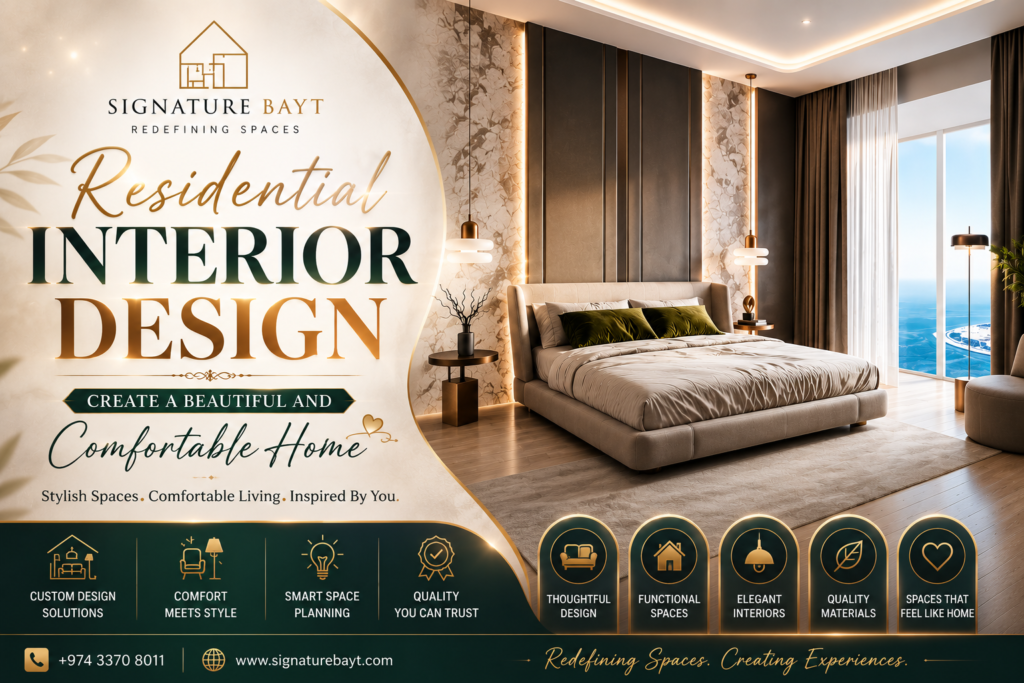
Residential Interior Design | Create a Beautiful and Comfortable Home is about creating spaces that feel natural to live in, not simply impressive to look at. A successful home should support everyday routines, provide comfort, offer enough storage, and reflect the personality of the people who live there.
In Qatar, residential design often needs to balance privacy, family living, entertaining, modern convenience, and elegant visual style. Therefore, a villa, apartment, majlis, bedroom, kitchen, or family lounge should be planned according to how the space will actually be used.
At Signature Bayt, the focus is on creating Residential Interior Design solutions that connect beauty with practical living. Every decision—from layout and lighting to furniture and materials—should contribute to a more comfortable and visually balanced home.
What Is Residential Interior Design and Why Does It Matter?
Residential Interior Design is the process of planning, designing, and styling living spaces to improve comfort, function, and appearance.
It goes beyond decoration. A strong design considers how people move, where furniture should be placed, how much storage is needed, and how lighting affects the atmosphere.
Key elements often include:
- Space planning
- Furniture layout
- Lighting design
- Colour selection
- Material coordination
- Storage solutions
- Custom furniture
- Decorative styling
When these elements work together, the home feels more organised and easier to use.
Create a Home That Matches Your Lifestyle
Every household has different priorities.
A family that regularly welcomes guests may need a formal majlis and separate family areas. Meanwhile, a smaller household may prefer open-plan living and flexible spaces.
Therefore, home interior design should respond to the people who live in the property rather than follow a generic layout.
Designers should consider:
- Family size
- Daily routines
- Guest requirements
- Privacy
- Storage
- Work-from-home needs
- Future family changes
This allows the home to feel personal instead of overly staged.
Balance Beauty, Comfort, and Everyday Function
A beautiful room is not successful if it is difficult to use.
For example, oversized furniture can reduce movement, while inadequate lighting can make a visually attractive room uncomfortable.
Therefore, good Residential Interior Design balances appearance with practical needs.
| Design Element | Main Purpose | Good Approach |
|---|---|---|
| Furniture | Comfort and movement | Match furniture to room size |
| Lighting | Visibility and mood | Use layered lighting |
| Storage | Organisation | Integrate practical storage |
| Materials | Style and durability | Choose based on room use |
| Layout | Better circulation | Keep pathways clear |
This balance makes the home feel more natural and functional.
Plan Every Room for Better Flow and Usability
Good planning should happen before major decorative decisions.
Designers first study room dimensions, doors, windows, natural light, storage needs, and movement between areas. Then, furniture and decorative elements can be added around that structure.
This is especially important in large villas, open-plan apartments, and homes with multiple family and guest zones.
Improve Living Room Layout and Comfort
The living room often becomes the centre of everyday family life.
A thoughtful living room interior design should support conversation, relaxation, and entertaining without making the space feel crowded.
The best layouts usually have a clear focal point, comfortable seating, balanced lighting, and enough space to move naturally.
A feature wall, television unit, artwork, or large window can become the main visual anchor. Then, furniture can be arranged around it in a way that feels intentional.
Create Calm and Relaxing Bedroom Interiors
Bedrooms should feel visually quiet.
Soft colours, warm lighting, comfortable fabrics, and practical storage usually work better than excessive decoration.
A well-planned bedroom interior design may include an upholstered headboard, bedside lighting, built-in wardrobes, curtains, and a few carefully selected decorative elements.
Moreover, keeping visible clutter to a minimum helps the room feel more restful.
Design Practical and Elegant Kitchens
A kitchen needs to work well every day.
Therefore, kitchen interior design should prioritise layout, storage, lighting, work surfaces, and durable finishes.
A practical kitchen should make it easy to move between preparation, cooking, washing, and storage areas. At the same time, finishes and colours should coordinate with the rest of the home.
In open-plan layouts, this visual connection becomes even more important.
Enhance Bathrooms with Smart Interior Solutions
Bathrooms can feel luxurious without being overly decorative.
Floating vanities, large mirrors, glass partitions, built-in storage, and layered lighting can make the room appear cleaner and more spacious.
However, material performance matters just as much as appearance. Therefore, moisture resistance, durability, and easy maintenance should guide the final selection.
Explore Popular Residential Interior Design Styles
Different homeowners prefer different visual directions.
Some of the most common Residential Interior Design styles include modern, contemporary, minimalist, luxury, transitional, classic, and modern Arabic.
The right style should complement both the architecture of the property and the lifestyle of the homeowner.
Choose Modern and Contemporary Interiors
Modern interiors often use clean forms, neutral colours, natural materials, and uncluttered layouts.
However, they do not need to feel cold.
Wood, fabrics, plants, rugs, and warm lighting can soften the overall look and make the space feel more welcoming.
As a result, contemporary homes can remain elegant while still feeling comfortable.
Add Luxury Without Making the Space Feel Heavy
Luxury interior design works best when quality is more important than quantity.
Marble, natural stone, wood, metal, glass, and premium fabrics can add sophistication, but they should be used carefully.
Instead of filling the room with decorative features, focus on proportion, craftsmanship, and a few strong materials.
This creates a more refined result.
Create Timeless Interiors with Natural Materials
Natural materials often age better than trend-based decorative finishes.
Wood, stone, linen, leather, and textured fabrics can add warmth while creating long-term visual appeal.
A neutral foundation also makes the home easier to update later. New artwork, rugs, cushions, or accessories can refresh the space without requiring a major redesign.
Use Color, Lighting, and Texture More Effectively
Colour, light, and texture affect how a room feels emotionally.
Therefore, they should work together rather than being chosen separately.
Select a Balanced Color Palette
A good colour scheme often starts with one main neutral shade.
Then, one or two supporting tones can be introduced through furniture, textiles, or decorative features.
For example, beige with walnut and cream creates warmth, while ivory with grey and gold feels more refined.
The goal is balance rather than using many colours at once.
Improve Ambience with Layered Lighting
Lighting should adapt to different activities.
General lighting provides visibility, while task lighting supports reading or working. Accent lighting can highlight artwork or architectural features, and decorative lighting adds personality.
Together, these layers make the room more flexible throughout the day.
Combine Materials for More Visual Depth
Mixing different surfaces adds richness.
For example, smooth stone can work well with warm wood, while glass can contrast with soft fabrics or textured walls.
However, too many competing materials can weaken the design.
Therefore, each finish should support the overall visual direction.
Add Decorative Details That Complete the Space
Artwork, mirrors, rugs, cushions, plants, books, and sculptures can make a home feel more personal.
Still, decoration should be controlled.
A few well-chosen objects often create a stronger visual effect than filling every available surface.
Maximize Space with Smart Furniture and Storage
Furniture should support the room rather than dominate it.
Before choosing pieces, designers should consider room size, circulation, windows, doors, and how the space will be used.
Choose Furniture That Fits the Room Properly
Furniture that is too large can make a room feel cramped. On the other hand, furniture that is too small can make a large room feel disconnected.
Therefore, proportions are essential.
Custom dimensions can be especially useful in rooms with unusual layouts.
Use Custom Storage to Reduce Clutter
Storage can become part of the design rather than a separate necessity.
Built-in wardrobes, media walls, wall shelving, under-stair units, and custom cabinetry can help keep the home organised.
Moreover, custom furniture can use difficult corners more efficiently.
Make Small Homes Feel More Spacious
Smaller homes can still feel comfortable and elegant.
Use lighter colours, mirrors, vertical storage, multifunctional furniture, and clear sightlines.
Also, avoid overcrowding the room with unnecessary pieces.
These simple choices can make a compact interior feel significantly more open.
Build a More Personal and Comfortable Home
A home should not feel like a showroom.
Instead, it should reflect the people living there.
Reflect Your Personality Through Interior Details
Personal style can appear through artwork, favourite colours, fabrics, books, or meaningful decorative pieces.
However, these details should still fit within the overall design concept.
That way, the home feels personal without becoming visually inconsistent.
Create Flexible Spaces for Changing Family Needs
Residential spaces often need to evolve.
A guest room may later become a home office. A children’s room may need a different layout as they grow. Similarly, a family area may need more flexible seating over time.
Therefore, adaptable layouts and practical storage can add long-term value.
Why Choose Signature Bayt for Residential Interior Design?
Professional Residential Interior Design requires more than creativity. It also requires planning, material knowledge, technical understanding, and coordination.
At Signature Bayt, each residential project is developed around the homeowner’s needs and the property’s characteristics.
Receive Tailored Design Solutions for Your Home
Every project should respond to:
- Property size
- Family lifestyle
- Preferred style
- Storage needs
- Existing architecture
- Future use
This creates a design that feels more individual and practical.
Work with Experienced Interior Designers
Experienced designers can identify potential problems before work begins.
Furniture scale, lighting positions, material combinations, storage, circulation, and room proportions can all be reviewed in advance.
As a result, costly adjustments during execution can often be reduced.
Visualize Your Home with 3D Design Concepts
3D interior design helps homeowners understand how the proposed space will look before implementation.
It can show furniture placement, wall finishes, flooring, lighting, ceiling details, colours, and materials.
Therefore, clients can make decisions with greater confidence.
Achieve Quality from Planning to Final Finishing
A good concept still requires careful execution.
From space planning and materials to furniture, lighting, decoration, and final finishing, every stage should support the same design direction.
This helps create a more polished and consistent result.
Transform Your Home with Signature Bayt
A well-designed home should make everyday living more comfortable while still reflecting the homeowner’s taste.
With thoughtful Residential Interior Design, it is possible to improve space utilisation, comfort, storage, lighting, and overall visual harmony.
Whether you are designing a villa, renovating an apartment, improving a majlis, or creating a completely new residential space in Qatar, Signature Bayt can help turn your ideas into a refined and practical home.
Frequently Asked Questions About Residential Interior Design
1. What is Residential Interior Design?
Residential Interior Design is the planning and design of living spaces to improve comfort, functionality, appearance, and everyday usability.
2. Why is Residential Interior Design important?
It helps improve layouts, furniture placement, lighting, storage, movement, and visual consistency throughout the home.
3. Which rooms can be included in a residential project?
Living rooms, bedrooms, kitchens, bathrooms, dining areas, majlis spaces, home offices, wardrobes, and family areas can all be included.
4. Which design style is best for modern homes?
Modern, contemporary, minimalist, luxury, transitional, and modern Arabic styles can all work well depending on the architecture and homeowner preferences.
5. How can a small home feel more spacious?
Use light colours, mirrors, multifunctional furniture, integrated storage, and clear circulation.
6. Why is lighting important in home interiors?
Lighting affects visibility, comfort, atmosphere, colours, and the way materials appear.
7. Does Signature Bayt provide Residential Interior Design in Qatar?
Yes. Signature Bayt provides tailored residential design solutions for villas, apartments, majlis spaces, bedrooms, kitchens, living rooms, and other residential areas.
8. Can custom furniture be included in the project?
Yes. Custom furniture can improve storage, fit unusual dimensions, and create a more coordinated interior.
9. Is 3D design useful before starting the project?
Yes. 3D interior design helps homeowners preview furniture, materials, lighting, colours, and layouts before execution begins.
10. How do I start a Residential Interior Design project with Signature Bayt?
Start by defining your property type, preferred style, functional needs, and priorities. Then, Signature Bayt can develop a tailored design direction from initial planning through final finishing.